Thursday, 29 November 2012

Announcing the Africa News Innovation Challenge winners

En Français


Digital tools are an increasing impetus for innovation across African newsrooms. From crowdsourcing content to using infographics to tell stories, journalists are finding new ways to report the news. We're excited to be supporting these innovators through the $1 million Africa News Innovation Challenge, announced in May this year—the latest in a series of projects to spur innovation in African journalism. 

Run by the the African Media Initiative, other partners include Omidyar Network, the Bill & Melinda Gates Foundation, the John S. and James L. Knight Foundation, the U.S. State Department, the Konrad Adenauer Stiftung (KAS) and the World Association of Newspapers and News Publishers (WAN-IFRA).  The response to the challenge was really enthusiastic, with more than 500 proposals submitted.

The 20 winners are all exciting digital journalism projects that will contribute to solving some of the biggest challenges facing the African media industry. They range from mobile apps to mobilise citizens against corruption and improved infographics to communicate complex issues, to developing new platforms for sharing content on buses and taxis. Key themes among the projects include a growing concern about manipulated online content, the security of communications with whistleblowers and sources, and the need to improve engagement with audiences.  

The projects have the potential to be replicated by media elsewhere in Africa, or to be scaled up across the continent, to create wide and sustained impact. Some projects will also develop new tools to support newsrooms and boost media revenues to support sustainable journalism. Winners will receive cash grants ranging from $10,000 to $100,000; technology support from a team of four developers at AMI’s jAccelerator lab in Kenya, and business development support from top media strategists affiliated with the World Association of Newspapers & News Publishers. Ten of the winners will also be flown to the Knight Foundation’s annual M.I.T. Civic Media Conference in the U.S., while the rest will be showcased at other important industry events.

The ANIC winners are:


  • actNOW (Ghana)
  • AdBooker (South Africa)
  • Africa Check (South Africa / Nigeria)
  • skyCAM (Kenya / Nigeria)
  • Africa’s Wealth (renamed NewsStack) (Nigeria / Namibia)
  • Citizen Desk (Mozambique)
  • Code4Ghana (Ghana)
  • ConvergeCMS (Kenya / Tanzania / Uganda)
  • CorruptionNET (South Africa)
  • DataWrapper (Nigeria / Senegal / Tanzania)
  • End-to-End (renamed LastMile Crowdmapping) (Liberia / Ghana / Kenya)
  • FlashCast (Kenya)
  • Green Hornet (South Africa)
  • ListeningPost (South Africa)
  • MoJo: Keeping media honest by monitoring online journalism (South Africa)
  • openAFRICA (Kenya / Nigeria / Rwanda / South Africa)
  • ODADI (renamed Code4SouthAfrica) (South Africa)
  • Oxpeckers (South Africa)
  • Wikipedia Zero (Cameroon / Ivory Coast / Tunisia / Uganda)
  • ZeroNews (pan-African)

You can learn more about the winners’ projects on the ANIC website.

We can’t wait to see how these innovations unfold and we look forward to working with more African journalists to help them use technologies to tell important stories.

Posted by Julie Taylor, Communications Manager, Sub Saharan Africa


====


Annonce des lauréats de l’Africa News Innovation Challenge


Wednesday, 28 November 2012

Street View on Google Maps now live in Botswana

En Français

Earlier this year we announced that Street View on Google Maps was coming to Botswana.  Now anyone can travel virtually to Botswana via Street View on Google Maps and explore the country’s unique scenery and world-renowned game reserves. Following the launch of Street View in South Africa just before the 2010 FIFA World Cup, Botswana will become only the second African country to be on Street View. For a demo on how Street View works, start here. 

Street View Car in Gaborone

Take an online safari around some of Botswana’s most unique places, by exploring salt pans like the Makgadikgadi Pan , or spot wild animals in the famous Chobe National Park, home to the largest concentration of African elephants in the world. You may prefer to wander the streets of capital city Gaborone, or immerse yourself in what the city has to offer on its outskirts.

        Chobe National Park elephants             Tsodilo (UNESCO rock art heritage site)

Botswana is well known for housing the world’s largest inland river delta, the Okavango, which spans more than 16,000 square kilometres. The delta is fed by the Okavango River and is an aquatic wilderness teeming with rich wildlife. From today, anyone can experience this dynamic backdrop in Street View.    With around 70% of the country being covered by the Kalahari desert, Botswana has diverse terrain including the delta and wide open grassland and savannah areas. Depending on which kind of terrain Pegman falls on, you can navigate around some of the most remote areas of the country.

Salt Pan                                                             Gaborone

Whether you are planning a safari, doing a homework assignment on Botswana, or promoting your local business - Street View will allow you to experience a slice of Botswana.  We hope to add more cultures, landscapes and sites as Street View continues to expand to new places.

Posted by Ory Okolloh, Policy Manager, Google Sub-Saharan Africa

====

Street View sur Google Maps a fait son entrée au Botswana

Nous avons annoncé cette année que Street View sur Google Maps allait arriver au Botswana.  C'est chose faite puisque vous pouvez désormais vous déplacer virtuellement au Botswana via Street View sur Google Maps et explorer les paysages exceptionnels du pays et ses réserves de grands fauves connues dans le monde entier. Après le lancement de Street View en Afrique du Sud juste avant la Coupe du Monde de football 2010, Botswana sera maintenant le deuxième pays africain à être visible sur Street View. Pour voir comment Street View fonctionne, cliquez ici. 

Partez faire un safari en ligne dans quelques-uns des sites les plus remarquables du Botswana : explorez les déserts salins tels que le Makgadikgadi Pan ou observez la faune du célèbre Chobe National Park, où vit la plus grande concentration d'éléphants africains dans le monde. Vous pouvez aussi choisir de déambuler dans les rues de la capitale, Gaborone ou de partir à la découverte des sites des environs, tels que la Gaborone Game Reserve. 


Le Botswana possède l'un des plus grands deltas intérieurs du monde, le Delta d'Okavango, qui s'étend sur plus de 16.000 kilomètres carrés. Le delta est alimenté par le fleuve Okavango et concentre une faune et flore aquatique d'une richesse exceptionnelle. Désormais, vous pouvez accéder en live à tous ces lieux via Street View. Le Botswana, dont environ 70 % est couvert par le désert du Kalahari, offre toute une variété de paysages, du delta à la savane, en passant par les vastes prairies sauvages. En fonction des lieux où Pegman s'aventure, vous pourrez naviguer à travers les endroits les plus reculés du pays.


Que ce soit pour préparer un safari, un exposé sur le Botswana, ou faire la promotion d'une entreprise ou d'une initiative locale, Street View vous permettra d'avoir un avant-goût du Botswana.  Au fur et à mesure que Street View continuera à s'étendre dans de nouveaux lieux, nous espérons pouvoir ajouter de nouvelles cultures, de nouveaux paysages et de nouveaux sites à explorer. 


Publié par Ory Okolloh, Policy Manager, Google Sub-Saharan Africa

Monday, 26 November 2012

Boosting start-ups in Africa

En Français


Google Africa and the Umbono program is excited to announce a new partnership with tech incubator 88mph in Cape Town. The 88mph accelerator program originally launched in Nairobi, and will now be available to entrepreneurs in South Africa. 88mph offers selected start-ups funding, mentorship, and visibility. Google will support this start-up community with mentoring, speaker programs, and workshops.

Why is Umbono making these changes?
Our goal was always to help kick-start the South African start-up community and bring the pieces of the ecosystem together. We’ve achieved that and the start-up community (“Silicon Cape”) has proven to be filled with talent, and more active investors are now involved. Our new partnership will provide even more resources to entrepreneurs in South Africa. Google for Entrepreneurs is supporting tech accelerators and hubs across Africa, and the new program to support 88mph in Cape Town is an exciting addition. The partnership is similar to Google’s other global entrepreneurship support efforts such as Eleven (Bulgaria) and Le Camping (Paris).

Success Stories
The Umbono program brought together a community of talent and angel investors, and helped seven startups get their feet off the ground; many of our teams have won international competitions and already received follow-on investments. We will continue to build on their great momentum to help grow the wider tech entrepreneurial ecosystem in Southern Africa.


What happens next?
Startups in Cape Town can now apply to be accepted into the 88mph program -  so if you know of any early-stage tech startups in the region, let them know !

More information

Posted by Johanna Kollar, Program Manager, Google South Africa

====

Dynamiser les start-up en Afrique

Google Afrique et le programme Umbono sont heureux d'annoncer un nouveau partenariat avec l'incubateur de technologie 88mph au Cap. Le programme d'accélération 88mph, lancé au départ à Nairobi, est désormais accessible aux entrepreneurs d'Afrique du Sud. 88mph assure des financements, un tutorat et une visibilité aux start-up  sélectionnées. Google soutiendra cette communauté de start-up via des tutorats, des programmes de conférences et des ateliers.

Pourquoi ces changements concernant Umbono ?
Notre objectif a toujours été d'aider la communauté des start-up sud-africaines à démarrer, et de mettre ensemble les pièces qui composent l'écosystème. Nous avons atteint cet objectif et la communauté des start-up (“Silicon Cap”) a démontré qu'elle était pleine de talent. Des investisseurs plus actifs y sont désormais engagés. Notre nouveau partenariat va offrir encore plus de ressources aux entrepreneurs en Afrique du Sud. Google for Entrepreneurs soutient les accélérateurs et les hubs technologiques à travers l'Afrique, et le nouveau programme de soutien à 88mph au Cap complète naturellement cette démarche. Le partenariat s'inscrit dans la droite ligne des autres soutiens de Google aux entreprises à travers le monde, telles que Eleven (Bulgarie) et Le Camping (Paris).

Success story à répétition
Le programme Umbono a réuni une communauté de talents et des "business angels" et a aidé sept start-up à décoller ; plusieurs de nos équipes ont remporté des concours internationaux et bénéficient déjà d'investissements de suivi. Nous allons poursuivre sur cette lancée et aider ainsi au développement du plus vaste écosystème entrepreneurial technologique en Afrique du Sud.    

Que va-t-il se passer ensuite ?
Les start-up du Cap peuvent désormais postuler pour participer au programme 88mph -  alors, si vous connaissez des start-up technologiques en phase de démarrage dans la région, faites-le leur savoir !

Plus d'informations

  • 88mph
  • Article sur le Bandwidth Blog à propos du lancement de 88mph. 
  • Lien G+ vers des photos (lancement du 17 oct.)

Poste par Johanna Kollar, directrice de programme, Google Afrique du Sud

Tuesday, 30 October 2012

En Français

Map of the Week: Upande’s Virtual Kenya

[Editors Note: Earlier this month we lauched morethanamap.com to showcase the unique features of the Google Maps API. As part of this project, each week we’ll be featuring one story from our global community of developers who are using the Google Maps API to start businesses, help improve their communities or save the environment.]

This week we move on from Bangkok to Nairobi where we met with the Upande Ltd team at their office in the home of Mark de Blois. Upande is a development shop in Nairobi, Kenya that provides web mapping and GIS solutions expertise to a diverse range of enterprise, NGO, and public sector clients. Although Upande is relatively small (about 10 employees at the time of our visit), the tightly knit team is creating a big impact around the world with the Google Maps and Google Earth powered Virtual Kenya project.

Virtual Kenya is an online interactive platform designed to allow more Kenyans to use and interact with spatial data in both educational and professional pursuits. Users can view, download, publish, share, and comment on various maps covering topics such as water sanitation, wildlife, or politics. According to Upande the goal of the Virtual Kenya project is to, “promote increased data sharing and spatial analysis for better decision-making, development planning and education in Kenya, while at the same time demonstrating the potential and use of web-based spatial planning tools."


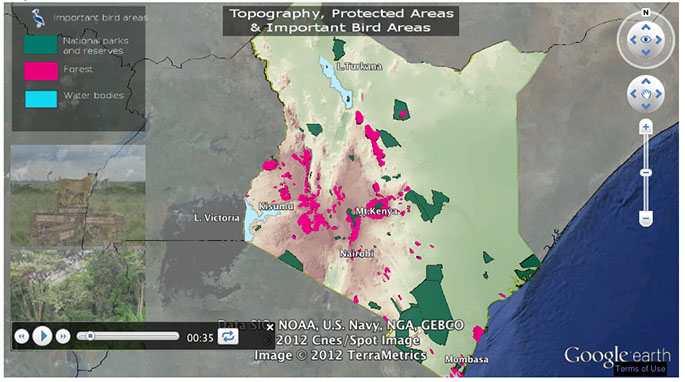
A big part of Virtual Kenya is making the data interactive and visually exciting, while also easy to access. To do this the Upande team uses the Google Earth API which allows them to use 3D map visualization directly on the site. In the screenshot above is an interactive tour that describes Kenya's tourism sector guided by Google Earth. This tour focuses on major attractions, national parks, environmental challenges, and areas that could be used to improve the industry. The full list of Virtual Kenya’s tours cover a variety subjects, such as deforestation, population issues, and threats to wildlife. Beyond the tours, there’s also a list of more Google Maps based mashups that help users learn more about a variety of subjects such as the Turkana Oil Fields, water quality, and aspiring politicians.

In the video below, Upande geo engineer Bernadette Ndege gives a live demonstration of how Virtual Kenya works.


Many thanks to the Upande team for inviting us into their office and sharing with us their latest projects. To learn more about Upande and the things that you can do with the Google Maps API, visit morethanamap.com. You can also see more pictures from our visit to Upande on Google+. Tune in next week to read about our visit with Ubilabs in Hamburg, Germany.


====


Carte de la semaine : Virtual Kenya selon Upande

[Note de l'éditeur : Ce mois-ci, nous avons lancé l'application morethanamap pour présenter les fonctionnalités de Google Maps API. Dans le cadre de ce projet, chaque semaine, nous vous proposerons un article sur la communauté mondiale de développeurs qui utilisent Google Maps API pour créer des entreprises, contribuer à l'amélioration de leurs communautés ou préserver l'environnement.]

Cette semaine nous quittons Bangkok pour rejoindre Nairobi où nous avons rencontré l'équipe d'Upande Ltd dans ses bureaux, sur les terres de Mark de Blois. Upande est une société de développement installée à Nairobi, au Kenya, qui offre son expertise en matière de solutions de cartographie web et GIS à un large éventail d'entreprises, d'ONG et de clients du secteur public. En dépit de sa taille relativement modeste (nous avons rencontré une dizaine employés lors de notre visite), l'équipe très soudée d'Uplande fait un travail dont les retombées ont un impact important dans le monde entier à travers le projet Virtual Kenya soutenu par Google Maps et Google Earth. 

Virtual Kenya est une plateforme interactive en ligne qui permet à un nombre croissant de Kenyans d'exploiter les données spatiales dans des applications à la fois pédagogiques et professionnelles. Les utilisateurs peuvent ainsi visualiser, télécharger, publier, partager et commenter différentes cartes couvrant des thèmes aussi variés que l'assainissement de l'eau, la faune et la flore sauvages ou la vie politique. Selon Upande, le projet Virtual Kenya a pour objet de « promouvoir le partage de données et l'analyse spatiale pour faciliter le processus décisionnel, développer la planification et l'éducation au Kenya, tout en démontrant le potentiel et l'utilité des outils de planification spatiale basés sur le Web. »

La mission principale de Virtual Kenya consiste à rendre ces données interactives, visuellement attractives et faciles d'accès. L'équipe d'Upande utilise pour cela Google Earth API qui lui permet d'appliquer directement sur le site la visualisation sur carte en 3D. La capture d'écran ci-dessus illustre un circuit interactif qui décrit le secteur du tourisme kenyan à l'aide de Google Earth. Ce circuit met l'accent sur les principales attractions, les parcs nationaux, les défis environnementaux et les domaines qui pourraient être exploités pour améliorer ce secteur d'activité. La liste complète des circuits Virtual Kenya couvre différents thèmes, par exemple la déforestation, les questions démographiques , ou les menaces sur la faune et la flore. L'application comporte également d'autres appli composites (Mashup) basés sur Google Maps qui permettent aux internautes d'en savoir plus sur toute une variété de thèmes tels que les champs pétrolifères de Turkana, la qualité de l'eau et les candidats à la vie politique.

Dans la vidéo ci-dessous, Bernadette Ndge, ingénieur géographe chez Upande, fait une démonstration en direct du fonctionnement de Virtual Kenya. 

Nous remercions vivement l'équipe d'Upande de nous avoir accueillis dans ses bureaux pour nous faire part de ses tout derniers projets. Pour en savoir plus sur Upande et sur les applications de Google Maps API, visitez le site morethanamap.com. Vous pouvez également retrouver toutes les photos de notre visite chez Upande sur Google+. Ne manquez pas notre rendez-vous de la semaine prochaine pour tout savoir sur notre visite chez Ubilabs à Hambourg en Allemagne. 


Publié par Carlos Cuesta, Product Marketing Manager, Google Maps API

Tuesday, 23 October 2012

Bringing Information to Ghanaian Voters

En Français

December 7th 2012, will be an important day for Ghana and Ghanaian voters.  Ghana has already established a reputation for a being a vibrant and stable democracy, and expectations are that the upcoming election in December will be yet another opportunity to reinforce the well-deserved reputation. During the election campaign period,  the Internet is increasingly playing a role in how Ghanaian citizens’ search for information about elections, and in how politicians seek to engage with voters.   

To meet this growing demand for information online around the elections, we embarked on several activities.  From training local journalists and political parties on digital tools for elections, to partnering with local media partners like Citi FM to hold Google+ Hangouts with leading candidates and local civil society groups, to livestreaming the IEA Evening Encounters in Partnership with IEA Ghana and MMG, to partnering our Google Student Ambassadors in Ghana with local civic group Ghana Decides - our focus has been on making elections-related information accessible and driving citizen engagement.


Today, we announce the launch of the Ghana Elections Hub, an information portal where you can keep track of news and information related to the Ghana election.  Following up on our past efforts in Nigeria and Senegal, it is one more step in our ongoing effort to make sure our users can easily find and share locally relevant information. 


Posted by Ory Okolloh, Google Policy and Government Relations Manager, Sub-Saharan Africa


====


Apporter des informations aux électeurs ghanéens

Le 7 décembre 2012, sera un grand jour pour les électeurs ghanéens et ghanéennes. Le Ghana s'est déjà forgé la réputation d'être une démocratie stable et dynamique, et tout porte à croire que les prochaines élections qui se tiendront en décembre seront une nouvelle occasion de renforcer cette réputation bien méritée. Durant la campagne électorale, Internet est de plus en plus consulté par les citoyens ghanéens pour trouver des informations sur les élections et par les hommes politiques pour interpeler les électeurs.
  
Pour répondre à cette demande grandissante d'information électorale en ligne, nous avons récemment entrepris plusieurs activités notamment : former les journalistes et partis politiques locaux aux outils électoraux numériques, signer des accords avec des partenaires de média locaux tels que Citi FM pour tenir des Google+ Hangouts avec de grands candidats et des organisations de la société civile locale, diffuser en direct sur Internet les "IEA Evening Encounters" en partenariat avec l'IEA Ghana et MMG, et associer les étudiants ambassadeurs de Google au Ghana au projet citoyen local "Ghana Decides". L'objectif de toutes ces activités était de rendre accessibles les informations électorales et d'encourager la participation citoyenne.

Aujourd'hui, nous annonçons le lancement du Ghana Elections Hub, un portail d'informations qui permet de suivre en ligne les actualités et informations relatives aux élections ghanéennes.  Après les initiatives que nous avons menées pour le Nigeria et le Sénégal, cette opération constitue un nouveau jalon dans nos efforts permanents à rendre l'information pertinente aisément accessible et partageable par nos utilisateurs.

Poste par Ory Okolloh, Google Policy and Government Relations Manager, Afrique sub-saharienne.

Friday, 12 October 2012

Bringing history to life

En Français

This week, Google launched 42 new online historical exhibitions, including Apartheid, D-Day and the Holocaust. The stories have been put together by 17 of our partners who have drawn on their archives of letters, manuscripts, first-hand video testimonials and much more. Much of the material is very moving—and some is on the Internet for the first time.


Amongst the stories told are exhibitions featuring archive material about Apartheid, including never-seen-before material about some of the most iconic heroes of the Struggle. The Apartheid stories have been put together by three of our partners in South Africa - the Steve Biko Foundation, the Nelson Mandela Center of Memory, and Africa Media Online. Some of the exhibitions you can explore include:

  • Steve Biko - on the the 35th anniversary of Steve Biko’s death, this series of exhibitions tell the story of a 15 year old’s political awakening in the midst of the Apartheid movement. Featuring nine documents never released in the public domain including his 1973 banning order, and his Black People’s Convention membership card.
  • Nelson Mandela  - an update of the current archives, featuring new videos and images covering his early life, his prison years and negotiating for democracy.
  • Apartheid events - Sharpeville Massacre, Soweto Riots, 1913 Land Act, Heads of Government, Women’s Anti-Pass March, 1994 elections, Treason Trial and a collection of Apartheid signs

As with the other archives that we’ve helped bring onto the Internet, including the Dead Sea Scrolls you can zoom in to see photos in great detail and search through millions of items for a specific country, person, event or date. Watch our video for some guidance about how to find your way around the exhibitions.

The historical collections are the latest chapter in the work of the Google Cultural Institute, following the  Art Project, World Wonders and the Nelson Mandela archives. We’re working closely with museums, foundations and other archives around the world to make more cultural and historical material accessible online and by doing so preserve it for future generations.

You can explore the many exhibitions at www.google.com/culturalinstitute. You can also follow us on our Google+ page. What you see today is just the start, so if you’re a partner interested in contributing your own exhibitions please complete this form.  

Posted by Mark Yoshitake, Product Manager, Google Cultural Institute


====

Faire vivre l'histoire

Cette semaine, Google a lancé 42 nouvelles expositions historiques en ligne, dont celles sur l'Apartheid, le Débarquement en Normandie (Jour J) et l'Holocauste. Les récits ont été rassemblés par dix-sept de nos partenaires qui ont mis à profit leurs archives : lettres, manuscrits, témoignages vidéo directs, etc. Ces éléments sont pour la plupart très émouvants — et certains sont sur Internet pour la première fois.

Parmi les histoires ainsi racontées, on trouve des archives sur l'apartheid, dont des éléments inédits sur quelques-unes des figures les plus emblématiques de cette lutte. Les récits sur l'apartheid ont été réunis par trois de nos partenaires en Afrique du Sud - la Fondation Steve Biko, le Centre de mémoire Nelson Mandela et Africa Media Online. Parmi les expositions que vous pouvez explorer :


Steve Biko - à l'occasion du 35e anniversaire de la mort de Steve Biko, cette série d'expositions raconte l'histoire du réveil politique d'un gamin de 15 ans au sein du mouvement anti-apartheid. Comprenant neuf documents inédits dont son interdiction de séjour en 1973 et sa carte de membre de la BPC (Black People Convention).
Nelson Mandela  - une actualisation des archives actuelles, dont de nouvelles vidéos et images couvrant sa jeunesse, ses années de prison et les négociations pour la démocratie.
Événements liés à l'apartheid - Massacre de Sharpeville, émeutes de Soweto, Land Act de 1913, chefs du gouvernement, marche des femmes anti-pass, élections de 1994, procès de Treason et une collection de symboles de l'apartheid
Comme pour les autres archives que nous avons aidé à mettre en ligne, dont les Manuscrits de la mer Morte, vous pouvez zoomer pour voir le détail des photos et rechercher parmi des millions d'items ceux qui concernent un pays, une personne, un événement ou une date particulière. Regardez notre vidéo pour avoir quelques conseils et vous y retrouver dans les différentes expositions.
Les collections historiques constituent le dernier chapitre du travail de l'Institut culturel de Google, après le projet Art, les merveilles du monde  et  les archives de Nelson Mandela. Nous travaillons en étroite collaboration avec les musées, les fondations et autres détenteurs d'archives à travers le monde pour mettre à disposition en ligne le maximum d'archives culturelles et historiques, et les préserver ainsi pour les générations à venir.
Vous pouvez explorer les nombreuses expositions sur www.google.com/culturalinstitute. Vous pouvez également nous suivre sur notre page Google+. Ce que vous voyez aujourd'hui n 'est qu'un début. Si vous avez envie de contribuer à cette aventure et de proposer votre propre exposition, veuillez remplir ce formulaire. 
Poste par Mark Yoshitake, Responsable produit, Institut culturel de Google